
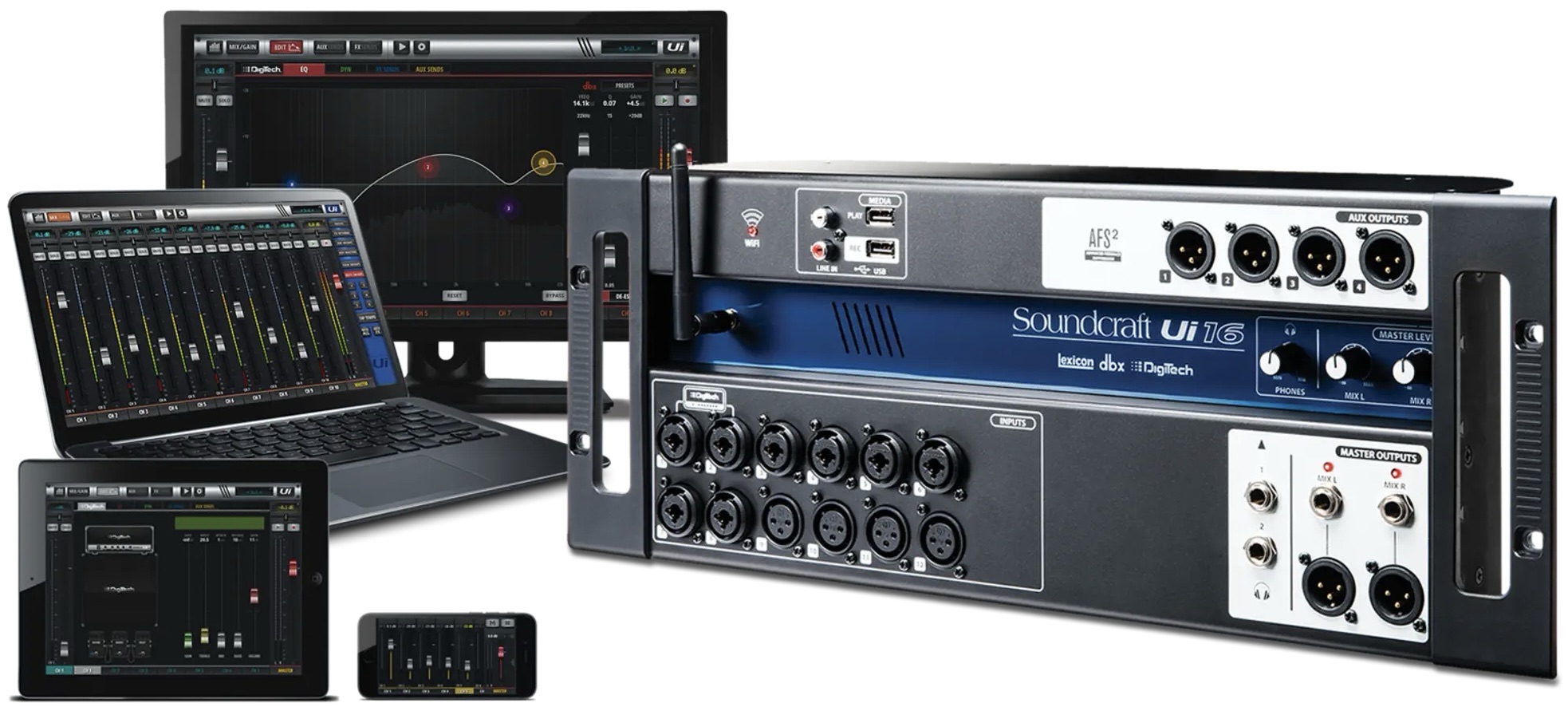
Our band leader’s former group had a digital mixer with Wi-Fi. Their sound technician could walk around with a touch-screen device. He listened at various locations and tweaked the mix as needed. I am a technology geek so the inherent flexibility of a system like that appealed to me.
Another factor that contributed to my choosing a digital mixer was actually the cabling. Gig setup is simpler because the mixer is placed on the stage near all the inputs. There is no need for a snake or other lonng cables to a remote, front-of-house mixing desk.
Why did I choose Soundcraft digital mixers?
- Price – this was probably the largest factor at the time. I was new to the band and live sound. I felt like their equipment was inadequate for the level of service a “sound guy” should provide, and I needed to buy a whole bunch of other gear, too. Among the digital mixers available on Reverb, eBay, and Craig’s List, Soundcraft provided the most value at a relatively low price. The first one also met my (ignorantly determined) minimum requirements and included a 4U Gator Pro roto-molded case.
- Features – reliability is very important in live performance. An attractive feature of the Ui-series mixers is that they have a web-server. A wirelessly connected device like an iPad accesses a web page. Since all settings are adjusted directly, changes are not lost if the wireless connection is lost. If you are somewhere without Internet access, it is not a problem because you do not need to download an app to add a new device. Also, there are no latency or driver issues. All this said, I should address connection consistency between the mixer and wireless device(s). There are many complaints in discussions and reviews about the wireless connection frequently dropping. Some folks have added a separate wireless router to deal with that. Other folks found that updating the Ui’s firmware resolved the issue, so that was my first action and I have not had issues.
My first mixer was a Soundcraft Ui16. It has twelve combination XLR/TRS inputs, USB and RCA inputs, two main outputs, and four auxiliary outputs. This mixer’s only shortcoming was its input and output capacity. In every other way, it performed as required. It is perfect for a smaller band and probably overkill for a home recording studio.
With a five-piece band, however, it did not take long to run out of inputs. My band has:
- Four singers
- Lead, rhythm, and bass guitars
- Full drum kit
- Congas
- Occasional guest singers and instrumentalists
My second mixer (the one we currently use) is a Soundcraft Ui24R, which has twenty combination XLR/TRS inputs, USB and RCA inputs, two main outputs, and eight auxiliary outputs. In addition to the neat features included in the Ui16, the Ui24Rs can be daisy-chained together for even more inputs. They can also record single and multi-track simultaneously.
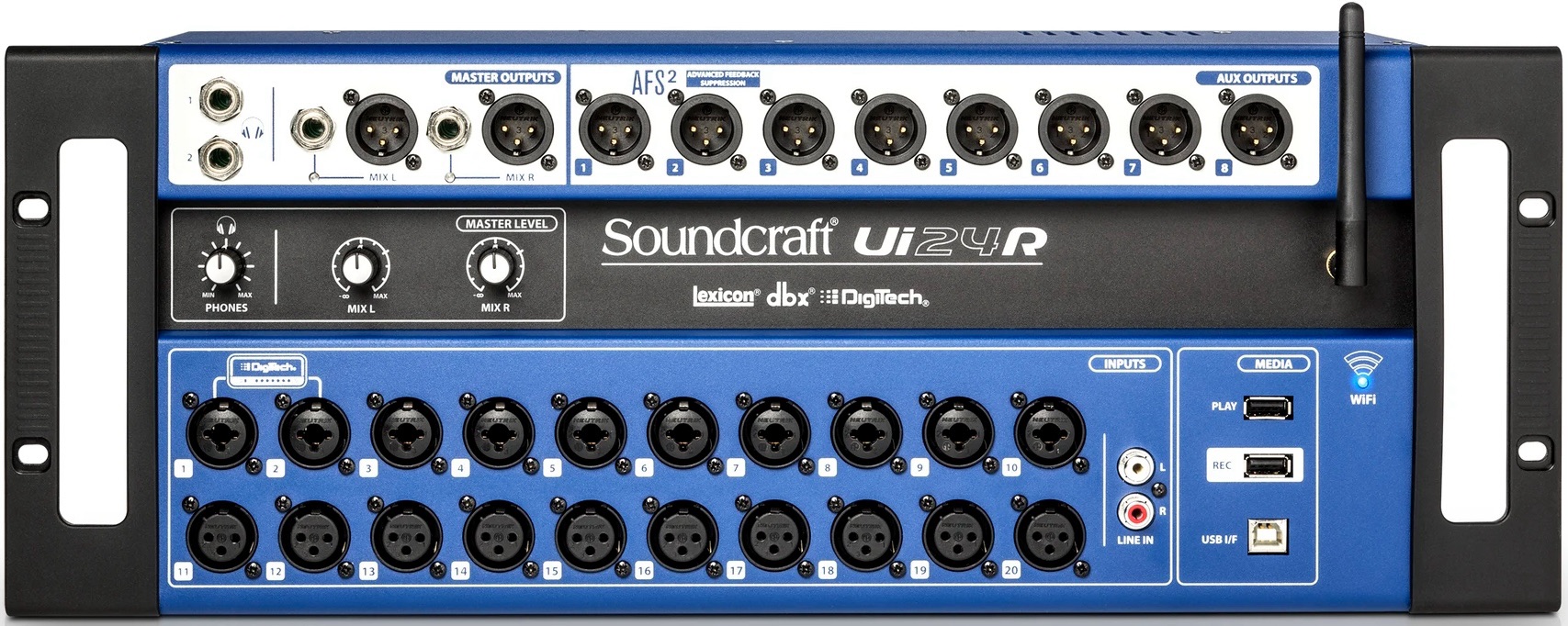
As with the smaller mixer, it has a built-in Wi-Fi router and webserver. I have been as far away as 40-feet without dropping the wireless connection. Also, we recently added additional wireless In-Ear Monitors, and I have had no issues with interference.
 Bennett AV